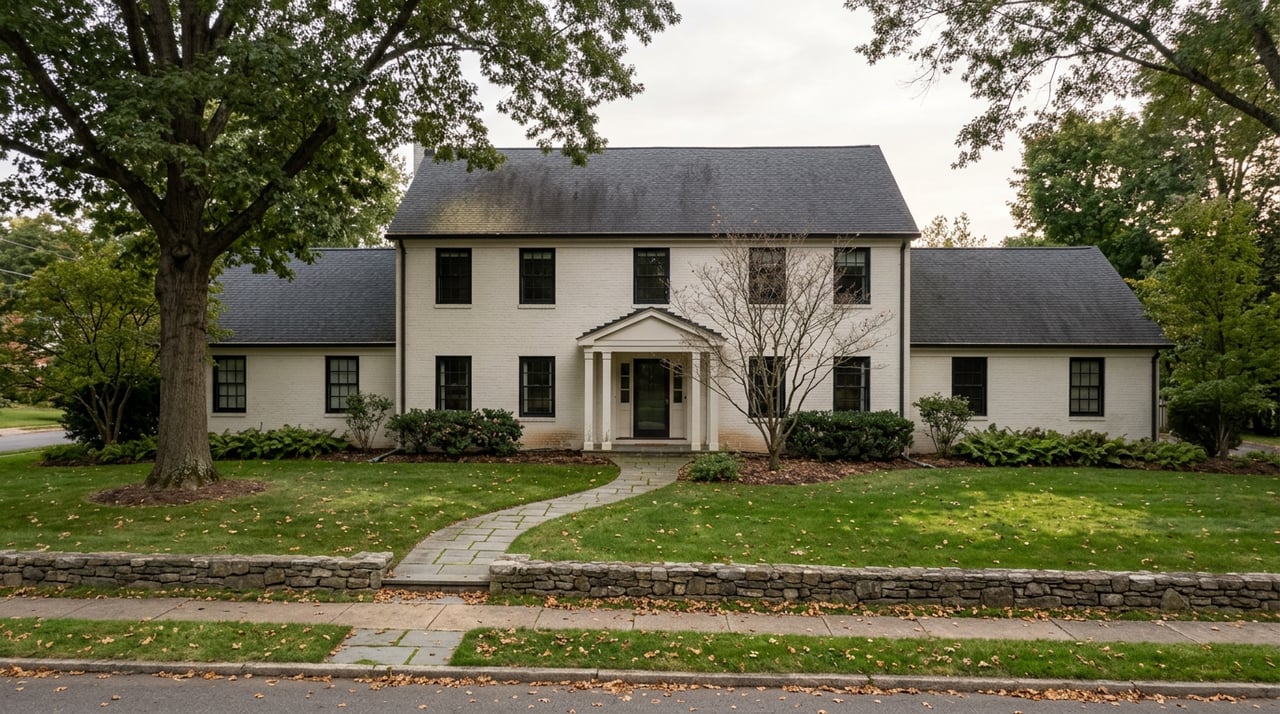
Picture a buyer three weeks from closing on a brick ranch near Beaver Lake. The inspection came back clean. The appraisal matched the contract price. Then their agent mentions, almost in passing, that before they frame in that garage they've been planning, they'll need sign-off from a five-person board that isn't the city, isn't an HOA management company, and doesn't answer to anyone but the neighborhood itself. The buyer asks the obvious question: where is this written down? The answer is not a bylaw packet. It's the deed to that specific house, filed sometime in the 1920s or 1930s, sitting in a folder at the Buncombe County Register of Deeds.
That's the thing about Lakeview Park that doesn't show up in a listing description. Most Asheville neighborhoods with shared amenities run on a standard homeowners association: one declaration, one set of bylaws, everyone under the same document. Lakeview Park runs differently. There isn't a single master agreement. There are roughly 516 individual deeds, each one carrying its own covenant language written when the neighborhood was platted, and each one legally binding on whoever owns that parcel today, no matter how many times it's changed hands since. The Lake View Park Commission itself describes these covenants as running with the land. That phrase matters more than it sounds like it should.
Not an HOA. Five Hundred Individual Contracts
A conventional HOA can amend its rules with a vote. Lakeview Park's foundational restrictions live inside deeds that were finalized nearly a century ago, and the Commission's role is closer to an enforcer of existing contracts than a rule-making body starting from scratch. The Commission itself is small: five members, elected each year at an annual meeting typically held the third Monday of October. Officers have specific portfolios. The Commission's chairperson, Bob Deutsch, is the point of contact for new construction, exterior renovations, and legal or property issues. The treasurer, Emily Wareham, handles assessments, liens, and what the Commission's own materials list as "realtor questions," a category specific enough that it tells you something about how often this comes up mid-transaction.
The practical difference for a buyer is this: you can't fully understand what you're buying into by reading a generic HOA disclosure packet. You have to pull the actual deed for that specific address. The Commission's own frequently asked questions page says as much, pointing buyers and anyone planning alterations toward the original deed on file at the county courthouse, because the restrictions written into one lot's deed may differ from the ones governing a lot two streets over.
The Setback Question With Two Different Answers
Here's where it gets concrete. The Commission's own public pages don't fully agree with each other. One page states that lots with less than 100 feet of frontage require a 10-foot side setback. Another page, describing the same rule, says 5 feet. Both are published by the same organization. Neither is wrong exactly, because both point back to the same underlying instruction: check your specific deed and plat, because setbacks vary by street and were never standardized across the whole neighborhood the way a modern subdivision's would be.
This isn't a criticism of how the Commission communicates. It's a preview of what due diligence actually looks like here. If you're buying a Lakeview Park property and you plan to build anything, an addition, a garage, a fence that pushes toward a property line, the number you need isn't on a website. It's in your deed and your plat, both of which the Commission and Buncombe County records can supply, but only if you go looking for the one that matches your parcel.
The same inconsistency shows up around assessments. One page describes the annual fee as based on frontage footage, a rate per linear foot of road frontage written into the original deed language. Another page on the same site says the assessment is based on lot size. As of 2020, the Commission's own FAQ listed the frontage rate at $3.04 per foot, a figure that predates the current market by several years and should not be treated as this year's number. What both descriptions agree on is the mechanism: bills go out in December, payment is due by January 31, and if it goes unpaid, the Commission files a lien. In cases of serious, sustained delinquency, the Commission states it will foreclose to protect the funds that maintain the lake and dam.
If you're buying a resale in Lakeview Park, that's a title question worth asking directly. A lien from an unpaid assessment attaches to the property, not just the previous owner personally, which is exactly the kind of detail that should surface during a title search rather than at the closing table.
The Case That Shows These Covenants Have Teeth
It's tempting to treat century-old deed language as a formality nobody actually enforces. That assumption doesn't hold up. In 2017, the North Carolina Court of Appeals heard Asheville Lakeview Props., LLC v. Lake View Park Comm'n, Inc., a dispute between a property owner and the Commission itself. The existence of an appellate-level case means this arrangement has been tested in an actual courtroom, not just debated at an annual meeting. For a buyer weighing whether the Commission's authority is real or symbolic, that's the answer: real enough to reach the Court of Appeals.
What This Means If You're Planning to Renovate
The build process here runs in a different order than most Asheville neighborhoods. In a typical transaction, a buyer pulls a city permit and starts work. In Lakeview Park, the Commission's governance materials are explicit that building plans for new construction, additions, or outbuildings must go to the chairman for approval before the city permit process, not alongside it or after. The stated standard is that a project should respect the deed's setbacks and match the scale and style of the existing home. Most plans that meet those two conditions get approved, but the sequence matters: skip the Commission step and you're not just risking a fine, you're risking a project that never should have started in the first place.
What This Means If You're Selling
Two covenant restrictions are worth surfacing early with any listing here, before a buyer's agent finds them independently. First, the deeds restrict use to single-family residential purposes. Long-term rentals are allowed under the covenants, but short-term rentals, the kind booked through Airbnb or VRBO, are explicitly forbidden, and the Commission states it enforces this when complaints come in. If a buyer is picturing this house as an income property booked by the week, that plan runs into the deed on day one. Second, subdividing a platted lot isn't permitted, which matters for anyone eyeing a larger parcel with an eye toward splitting it later.
Neither restriction is a defect. Both are simply part of what the property is, and naming them upfront tends to save everyone a harder conversation two weeks into a contract.
A Quick Reference for Due Diligence
| Question | Where the answer actually lives |
|---|---|
| What are my setbacks? | Your property's original deed and plat, not the Commission's general FAQ |
| Do I need approval to build an addition or garage? | Yes, from the Commission chairman, before the city permit process |
| Can I rent this out short-term? | No. Covenants restrict use to single-family and long-term rental only |
| Can I subdivide the lot? | No, subdivision of a platted lot is not permitted under the covenants |
| What happens if assessments go unpaid? | A lien is filed, and in serious cases the Commission can pursue foreclosure |
A Few Questions Worth Asking Before You Write an Offer
Is Lakeview Park's system technically an HOA? Not in the modern sense. There's no single master declaration that governs every property equally. Instead, the covenants are embedded in each original deed, and the Commission's job is to interpret and enforce what's already written rather than pass new rules by majority vote the way a typical HOA board does.
Where do I actually get my property's deed and plat? The Commission's own guidance points buyers to the Buncombe County Register of Deeds, since that's where the original filings from the 1920s, 1930s, and 1940s are kept on record.
Does the lake add value or does it add friction? Both, honestly, and that's not a dodge. Beaver Lake and the surrounding common ground are genuinely part of what makes these lots desirable. The same private ownership structure that maintains that lake is also the structure that reviews your renovation plans and bills your assessment. Understanding one means understanding the other.
If you're weighing a purchase in Lakeview Park, or getting ready to list a home there, the details in a decades-old deed shouldn't be the thing that slows down your closing. That's exactly the kind of groundwork the Mike Miller Team walks through with clients before an offer ever goes in, because in a neighborhood like this one, the fine print is the point. Start Your Buying or Selling Journey with a team that already knows where to look.