Open four browser tabs and search the same North Asheville zip code, and you will get four different answers to what should be a simple question. Ask what the typical home costs in 28804 this year and one source tells you $566,000. Another says $583,799. A third puts it at $477,200. None of these numbers are wrong. They are measuring different things, in different months, using different methods, and they are all trying to describe a zip code that does not actually behave like one market.
North Asheville, the area covering most of 28804, stretches from the Grove Park Inn golf course fairways down through a 1914 streetcar suburb and out to the edge of the UNC Asheville campus. A buyer with $260,000 and a buyer with $1.33 million are both shopping in "North Asheville." They are not shopping in the same place, and no single median can tell either one what they actually need to know.
Four Sources, Four Numbers, Same Zip Code
Here is what checking the data this year actually turns up:
| Source | What it's measuring | Figure | As of |
|---|---|---|---|
| GreatData.com | Public records aggregation | $566,000 | July 2026 |
| Zillow Home Value Index | Smoothed typical value, 35th to 65th percentile | $583,799 | April 2026 |
| ZipCodesToGo.com | American Community Survey estimate | $477,200 | 2024 ACS vintage |
The spread between the low and high figure is more than $100,000, inside the same boundary line. Part of that gap is timing. Part of it is method: a smoothed index built to filter out extremes will land somewhere different than a raw records aggregation, and a Census-based estimate will always lag behind whatever is actually closing this quarter. But most of the gap comes from something simpler. Each source is drawing a different mix of homes into its sample, and 28804 has an unusually wide mix to draw from.
The Golf Course End of Kimberly Avenue
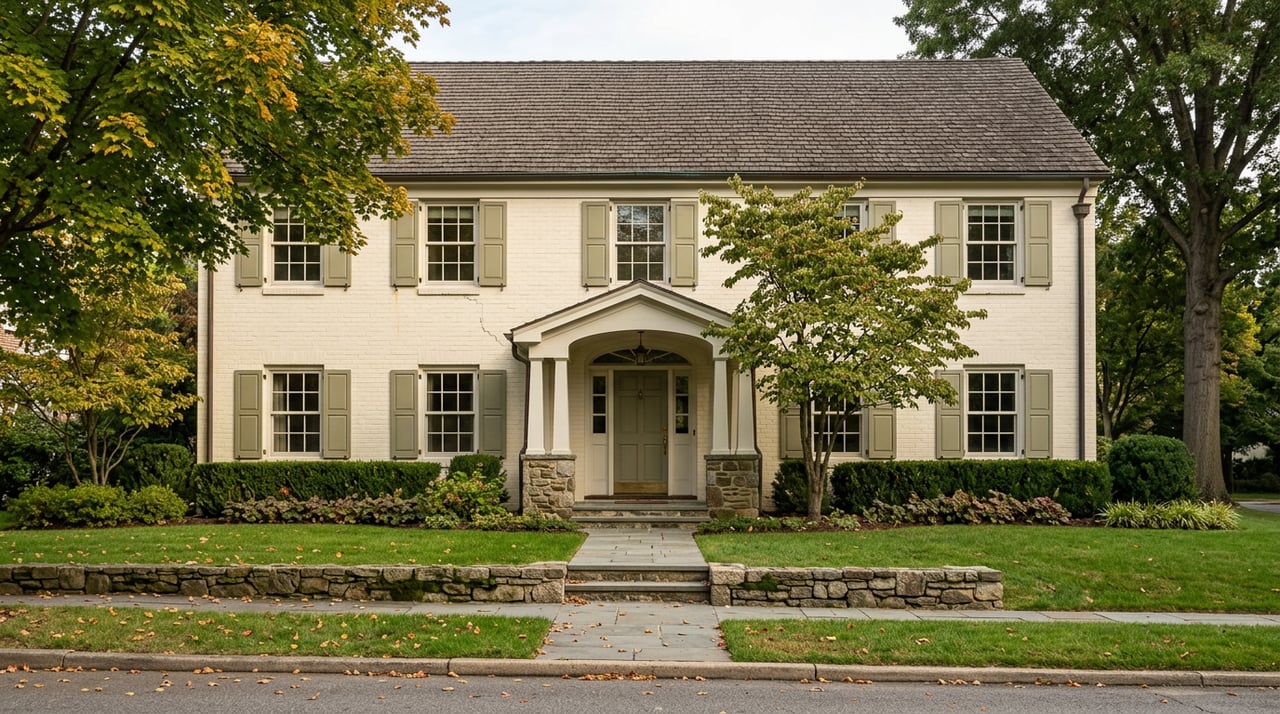
At the top of that mix is Kimberly Avenue, the winding road that runs along the Grove Park Inn's fairways with a row of homes across the street facing the course. The architecture here is an eclectic run of Colonial Revival, Mediterranean, and other styles built mostly from the 1920s through the 1940s, many of them shaded by mature sugar maples that turn the street gold every fall.
Two recent closings show what this end of the range actually looks like in practice. A home at 9 Griffing Blvd sold in March 2026 for $1,250,000, three percent under its $1,290,000 list price, after 175 days on the market. A few blocks over, 21 Lynwood Rd closed in January 2026 at $1,330,000, fifteen percent under its $1,560,000 asking price, after 115 days. These are not distressed sales. They are simply homes that took months to find a buyer willing to pay a price closer to the seller's number than the list suggested.
That detail matters more than the sale price itself. If a $1,250,000 median from this corridor is quietly pulled into a zip-level average, it drags the whole 28804 figure upward even though it took nearly six months to close, and even though it says nothing about what happens to a home listed at half that price two miles away.
Norwood Park's historic district, listed on the National Register of Historic Places in 2008, includes more than 150 contributing buildings from the neighborhood's original 1914 development, according to the nomination form filed with the North Carolina State Historic Preservation Office.
The Bungalow Middle Between Merrimon and Kimberly
Drop down from the golf course and you land in Norwood Park, platted in 1914 as part of the national "Suburb Beautiful" movement, back when Asheville's streetcar line made this stretch newly reachable from downtown. The streets curve with the natural topography instead of running in a grid, a design choice that was unusual enough at the time to be part of the neighborhood's historic designation. Because the plan anticipated the automobile from the start, most blocks were laid out with rear alleys and small garages, a detail that still shapes how these lots sit today.
The housing stock is Arts and Crafts bungalows built mostly in the 1910s and 1920s, many with original hardwood floors and brick fireplaces that have been carefully maintained rather than gutted. The neighborhood sits between Merrimon Avenue and Kimberly Avenue, close enough to walk to Luella's Bar-B-Que and to Weaver Park, which has tennis courts, a baseball diamond, and greenway trail access. Merrimon itself functions as the commercial spine for the whole district, with a Whole Foods, a Trader Joe's, and a Fresh Market covering the daily errands that would otherwise mean a drive downtown.
This is the pocket that most resembles what people picture when they hear "historic Asheville bungalow." It is also the pocket that gets least mentioned when someone quotes a single 28804 median, because it is neither the cheapest nor the most expensive slice of the zip code. It sits in the middle, doing the least to explain the headline number in either direction.
The Pocket Near UNCA That Never Makes the Aggregate
Then there is the stretch around UNC Asheville, where the housing mix shifts again. Here you find mid-century ranches and split-levels built in the 1960s alongside smaller, student-adjacent cottages that never show up in a Kimberly Avenue photo tour. A few miles north, Woodland Hills continues the same story with brick ranches developed in the 1960s between Asheville and Weaverville, the kind of inventory built for young families rather than for a golf course view.
This is the part of 28804 most likely to get left out entirely when a source talks about "North Asheville luxury" or "historic estates." It is not glamorous inventory, but it is real inventory, and it is often the segment where a buyer working with a tighter budget can actually compete, because it is not the segment other buyers are searching for when they type "North Asheville" into a portal.
The zip code's actual floor shows up in the same window as the Griffing Blvd and Lynwood Rd closings. A one-bedroom, one-bath condo at 24 Chatham Rd closed on July 30, 2026 for $260,000, ten percent under its $289,000 list price after 68 days on the market. A four-bedroom home at 115 Northbend Dr sold the next day for $395,000, right at its $395,000 asking price, after 133 days. Neither sale carries a golf-course view or a century of architectural pedigree. Both are 28804. Both belong in the same conversation as the $1.33 million sale on Lynwood Rd, and none of the four zip-level medians above can hold all three at once.
How to Actually Compare What Your Money Buys
A zip-level median cannot tell you which of these three markets you are shopping in. Here is what actually helps:
- Pull closed comps from the specific street or subdirectory you are considering, not the zip code average. A Kimberly Avenue comp tells you nothing about a Norwood Park listing three blocks away.
- Check days on market alongside price. Both Griffing Blvd and Lynwood Rd sold well under their original list prices after four to six months. A high asking price is not the same thing as a fast sale or a firm price.
- Match the era to the systems. A 1920s Norwood Park bungalow and a 1960s Woodland Hills ranch carry different renovation histories, different original materials, and different maintenance patterns, even if they land at similar price points today.
- Ask which pocket a given aggregator's number is actually drawing from before you anchor to it. A smoothed index, a public records average, and a Census estimate will each tell a slightly different story about the same 200-acre area.
Why This Matters More Than the Headline Number
None of this means North Asheville is overpriced or underpriced. It means the single number attached to the zip code is doing the impossible job of describing a golf-course corridor, a century-old streetcar suburb, and a university-adjacent starter pocket all at once. Treat that number as a rough compass rather than a price tag, and put the real weight on comps from the specific street, in the specific style, from the specific months you are actually shopping in.
A Few Questions Worth Asking
Does 28804 map exactly onto "North Asheville"? Not precisely. The zip code also touches neighboring areas outside the city line, so a "North Asheville" figure pulled from zip-level data is already blending in some homes most people would not describe as North Asheville at all.
Is the priciest corridor also the fastest-moving one? Not necessarily. Both recent Kimberly Avenue-area sales referenced here took well over one hundred days to close and sold under their original asking prices, which is a different pattern than a home priced correctly for its specific pocket from day one.
What is the fastest way to tell which pocket a listing sits in? Look at the build era and the immediate cross streets rather than the zip code. Norwood Park, the Kimberly corridor, and the UNCA-adjacent pocket each have distinct architectural signatures that tell you more than any aggregate figure will.
Every one of these pockets has its own rhythm, its own comps, and its own reasons a price makes sense or does not. If you are trying to figure out which one actually fits your budget and what you are looking for, the team at The Mike Miller Team can walk through the real comps with you, street by street, instead of the zip code average.